International Space Station (ISS) Tracking, Live Videos, NASA TV
Space Station Live Tracking
Space Station Live Video - Earth Viewing Experiment
Space Station Live Video - Interior Station Views & Earth Views
NOTE: Space Station Live Video (above) includes interior views and live audio from radio transmissions between the crew and Mission Control when the crew is on duty. Earth views are shown at other times.
The video is available only when the space station is in communications contact with the ground. A blue video screen will be seen during "loss of signal" periods. Since the station orbits the Earth once every 90 minutes,
it experiences a sunrise or a sunset about every 45 minutes. When the station is in darkness, external camera video may appear black, but can sometimes provide spectacular views of lightning or city lights below.
NASA TV - Live space missions, events and pre-recorded educational, public relations programs
NASA TV provides programming 24 hours a day. Programs include "NASA Gallery" -- photographs and video from NASA's history; "Video File" -- broadcasts b-roll footage for news and media outlets; "Education File" -- special programming for schools; "NASA Edge" and "NASA 360" -- hosted programs focus on different aspects of NASA; and "This Week @ NASA" -- news from NASA centers around the country. Live ISS coverage and related commentary is aired daily at 11 a.m. EST and repeats throughout the day. The network also provides live programming such as 24-hour coverage of ISS events (spacewalks, media interviews, educational broadcasts), press conferences and rocket launches. These often include running commentary by members of the NASA Public Affairs Office who serve as the "Voice of Mission Control," including Rob Navias, Josh Byerly, Nicole Cloutier and Brandi Dean.
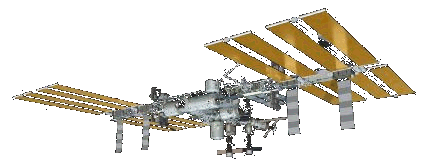
 To International Space Station To International Space Station
The International Space Station (ISS) provides a permanent laboratory
in a realm where gravity, temperature and pressure can be manipulated
to achieve numerous scientific and engineering pursuits that are impossible
in ground-based laboratories. The space station has become a test bed for
the technologies of the future and a laboratory for research on new, advanced
industrial materials, communications technology, medical research and
much more.

© Charlie Bautsch, W5AM (SpaceTeam.net)
Engineer: Dr. Bautsch; ISS, Space Station, Spacelog, Spaceteam, Spacetrans, Spaceman, Spaceportation, Lonestar Cam, SpaceCom, Spacevoy, Spaceship Texas, live streaming video, Radio NASA, NASA TV, JSC, Spacecity USA.
|
|
